To stay competitive in today’s global markets, California manufacturers must continually look for new ways to reduce defects, improve consistency, and increase productivity, all while meeting or exceeding customer expectations.
ISO 9001, the global standard for implementing a quality management system (QMS), was designed to help organizations do just that.
While many organizations pursue ISO 9001 certification because it is often a contract requirement for customers, the greatest value this ISO certificate provides comes from the operational improvements manufacturers can gain by implementing a structured QMS.
Rather than view ISO 9001 certification as an expense, manufacturers should view it as an investment in a certified quality management system that sets a foundation for improving quality, reducing waste, and creating long-term value.
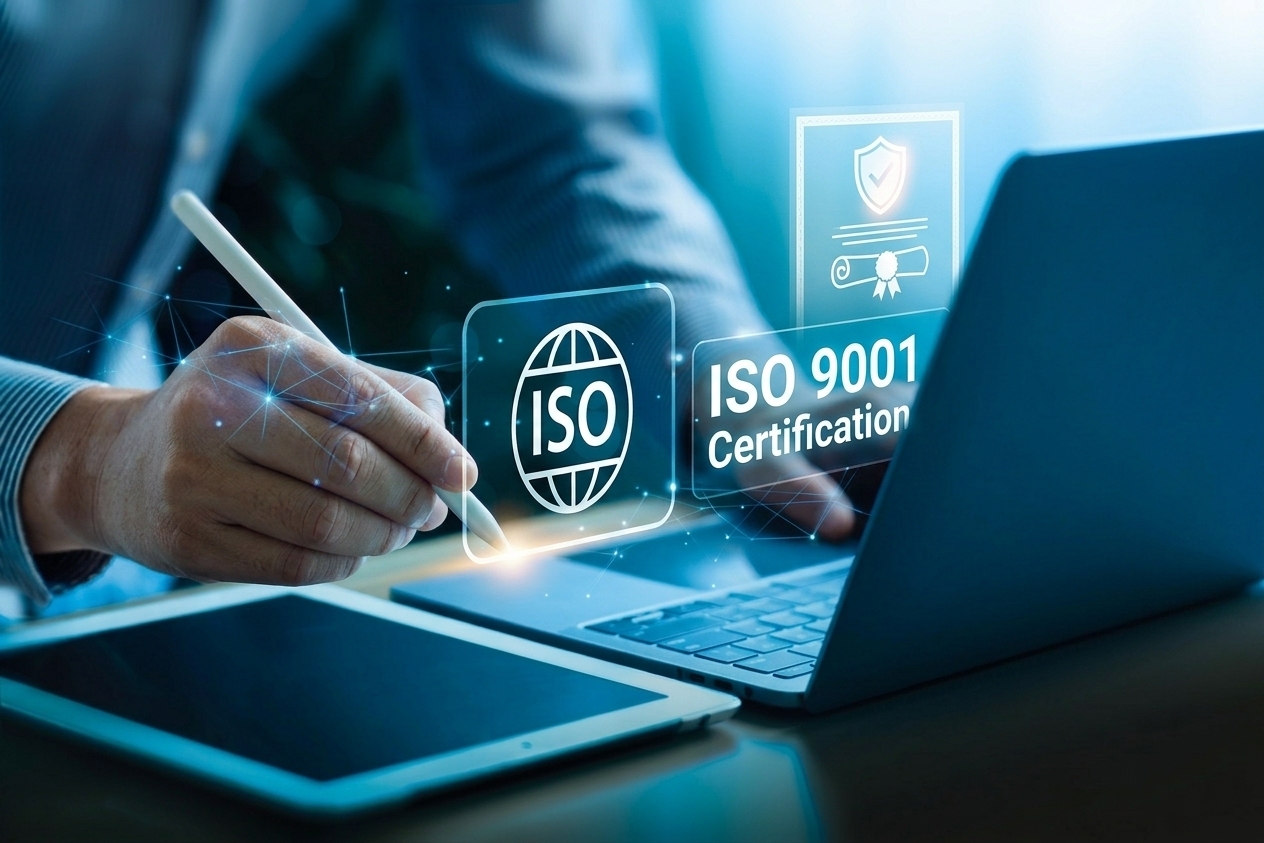
What is ISO 9001 Certification?
ISO 9001 is the internationally recognized standard of requirements for the development and implementation of a quality management system. As one of the world’s most commonly held certifications, it has helped thousands of companies improve their processes.
However, many manufacturers delay or put off ISO 9001 certification due to the perceived expense. While there is no universal number, what often goes unappreciated about ISO 9001 certification is the material benefit it brings to an organization.
An ISO certificate is about more than simply completing paperwork. ISO 9001 provides a framework for building a structured system that creates consistent, repeatable processes in an organization, helping organizations manage risk, meet customer requirements, and continually improve their operations.
To become ISO 9001 certified, a company must complete an independent audit by an accredited certification body. During the audit, the goal isn’t just to verify that the organization’s QMS meets the requirements of the ISO 9001 standard, but to see that it is being used in day-to-day operations.
Why ISO 9001 Certification Matters
Increasingly, ISO 9001 certification is becoming a requirement for bidding on contracts or qualifying for approved vendor programs. Large OEMs, government agencies, prime contractors, and regulated industries are all more likely to require that their partners have a certified QMS.
But beyond the enhanced ability to compete for jobs, ISO 9001 certification offers several other major benefits to organizations willing to invest in themselves.
One of the biggest challenges facing manufacturers is process inconsistency. Organizations without a formal QMS often become more reliant on experienced employees who work from memory, verbal instructions, spreadsheets, or “tribal knowledge”.
That approach often works fine, until a key employee leaves or retires, production volume increases, or customers become more demanding. Suddenly, these organizations can find themselves struggling to achieve both quality and productivity. Documenting processes through a QMS helps formalize everyday work procedures. It also makes it easier to bring in new talent, expand production, and reliably repeat processes.
One often-overlooked expense is the cost of poor quality. Becoming ISO 9001 certified also helps organizations reduce the occurrence of scrap and rework. By implementing a QMS, manufacturers are more likely to pinpoint the root causes of defects, rather than simply react to them. A QMS helps management take steps to correct issues, resulting in fewer production delays and customer complaints, while also reducing wasted spending.
For manufacturers, ISO 9001 certification isn’t a magic wand that will automatically guarantee defect-free products. However, certification does prove to customers that an organization takes quality seriously. Manufacturers who hold the certification demonstrate that they have documented processes for evaluating performance and continually managing the quality of their products.
Understanding the Investment Required for ISO 9001 Certification
One of the most common questions manufacturers ask is “how much does ISO 9001 certification cost?” however there is no simple number.
A small manufacturer with well-established processes might have a very different investment and timeline for certification than a larger operation that needs to build a quality management system from the ground up.
The answer depends on the size and complexity of the company, and whether or not there is any sort of quality system currently in place.
Rather than try to predict a single price range for all organizations, it’s best to break the cost of ISO 9001 certification down into several categories.
Working With an ISO 9001 Consultant
While it is entirely possible for an organization to prepare for an ISO certification audit on their own, many organizations don’t have the internal quality expertise to do so. Instead, they choose to work with a manufacturing consultant who can help them prepare.
Consultants often help with the development of the QMS itself, assist with documentation, and conduct gap assessments and mock audits. They often develop and implement corrective actions, and help train employees to work within the framework of the QMS.
The fees charged by an ISO 9001 consultant in California tend to vary based on the size of the organization and its existing quality infrastructure.
ISO Certification Audit
Achieving the certification requires passing an audit conducted by an accredited certification body, also known as a registrar.
The cost of a certification audit typically depends on the number of employees in an organization as well as the number of locations. The complexity and scope of the operation also play a role in determining the audit investment.
Internal Resources and Implementation
Successfully implementing a QMS and achieving ISO 9001 certification requires more than just completing paperwork. Each company must dedicate time, resources, and man-hours to developing procedures, training employees, conducting internal audits, and implementing corrective actions. This can be hard to estimate, because it depends so heavily on what systems are already in place and what is being built from scratch.
Maintaining an Effective Quality Management System
Achieving ISO 9001 certification is only the first step in a commitment to quality. Certification follows a three-year cycle. However, most certification bodies conduct annual surveillance audits, before a full recertification audit is required. Internal audits and management reviews are also essential for keeping the QMS working and supporting continuous improvement.
How Long Does It Take to Get ISO 9001 Certification?
How long it takes to become ISO 9001 certified depends on each organization’s size, the complexity of their operations, and whether they are building a QMS from scratch or refining an existing one.
Many small to mid-sized manufacturers can complete the certification process in anywhere from six to twelve months. Companies with more mature quality management systems may be able to achieve certification more quickly, sometimes in as little as three months.
While every organization is different, the process moves through several phases.
Gap Assessment
For most organizations, the certification process occurs over several phases, beginning with a gap assessment. Over several weeks, the gap assessment will evaluate the existing QMS against the requirements of ISO 9001. This step identifies the organization’s strengths and weaknesses, and helps create a roadmap for the project. Working with an ISO 9001 consultant in California can help get the process started on the right foot.
QMS Development
Most organizations will spend the next several months developing their Quality Management System. When there is already a functioning QMS in place, this step can focus on closing the gaps. If an organization is starting from scratch, they will need to spend more time documenting key processes and work instructions, establishing documentation control procedures, defining quality objectives and metrics, and creating internal audit procedures and corrective measures. That alone can take several months.
Employee Training
After the QMS has been documented, it needs to be put into practice and employees trained. This phase can easily take up the bulk of the timeline over several months. Employees must thoroughly understand their responsibilities, follow documented procedures, and generate the records and evidence that demonstrate the system is functioning effectively.
Internal Audit
Prior to scheduling the ISO 9001 certification audit, it’s smart to conduct an internal audit. This step helps confirm that the QMS meets ISO certification requirements and is operating effectively before involving real auditors. Management will have time to review any remaining gaps and implement corrective actions. This part of the process can take anywhere from a few weeks to a month or longer.
Scheduling and Passing the Audit
Once management has reviewed the performance of the QMS, it’s time to schedule the certification audit. The audit itself typically has two phases. In the first, the auditor will review documentation and assess readiness. During the second stage, the auditor will evaluate the implementation of the QMS and verify that the processes are operating effectively.
If the auditor identifies nonconformities, the organization is typically given an opportunity to address them before the certification is issued.
The biggest takeaway is that the pathway for achieving ISO 9001 certification will look different for every company. The process is about much more than simply creating documentation: it requires implementing a fully functional quality management system that employees can understand, follow, and work to continuously improve.
That process takes time. Working with an ISO certification consultant can help speed up the process.
Is ISO 9001 Certification Worth the Investment?
When considering how much ISO 9001 certification costs as well as the timeline for achieving it, it’s natural to ask if the commitment is worth the investment.
However, experienced manufacturers understand that the greatest potential for return on ISO 9001 certification isn’t just the ability to qualify for more new contracts, but the operational improvement it creates.
Scrap, rework, production delays, customer complaints, and warranty claims all carry significant hidden costs. Implementing a well designed QMS can help reduce these costs that otherwise drain a manufacturer’s profitability. Creating standardized, repeatable processes while building a culture of continuous improvement helps manufacturers generate returns year after year that can exceed the initial investment in certification.
At Manex, we believe that makes ISO 9001 one of the best investments manufacturers can make.
The operational improvements ISO certification brings include increased efficiency, higher quality, and reduced waste and rework. Certification also signals trust to customers, and increases the pool of available contracts, where ISO 9001 certification is a requirement for doing business.
Some of the most lucrative opportunities to work with OEMs and government contracts require ISO 9001 certification. Demonstrating a commitment to quality creates greater growth and business opportunities, unlocking many contracts that might otherwise be out of reach.
Manex: ISO 9001 Consulting for California Manufacturers
Manufacturers that make an investment in ISO 9001 aren’t simply getting paperwork done. They are creating a more disciplined and efficient version of their organization. While achieving certification requires an investment of time and resources, the operational improvements in efficiency, quality, and waste reduction create value that far exceeds the certification process itself.
Interested in becoming ISO 9001 certified? Manex can help you prepare.
For over 30 years, we’ve helped California manufacturers take their commitment to quality to the next level with complete preparation for ISO 9001 certification.
Whether you’re a small manufacturing company starting from scratch, or an established supplier looking to formalize your QMS, we offer a full range of programs designed to help you achieve certification.
Our team can help you conduct gap analysis, develop, document, and implement a QMS, and conduct employee training. We can help you conduct mock audits and prepare for the audit process.
Don’t wait any longer to commit to quality. Contact Manex today to speak with our team for an initial consultation to explore ISO 9001 certification for your organization.